/filters:quality(90)/fit-in/970x750/coros-web-faq/upload/images/bead1e125c20dd7adbf51b0b7779d2e7.png)
For the first time in history, ski mountaineering, "skimo", stepped onto the Olympic stage.
On average, nearly 24 million viewers in the U.S. tuned in daily during Olympic coverage, with billions of minutes watched globally. For many endurance athletes, this was their first exposure to a sport that looks like a hybrid of trail running, uphill intervals, and downhill ski racing.
But what does skimo actually demand from the body?
And more importantly for runners, cyclists, climbers, and hikers:
Could this be the most powerful off-season training tool you’re overlooking?
COROS captured the data. Let’s break it down.
First, What Is Skimo?
Skimo racing combines steep uphill ascents on skis (with skins attached for grip), rapid transitions, and aggressive technical descents. Olympic formats like the Sprint and Mixed Relay compress the effort into short, high-intensity efforts lasting just minutes per lap.
Unlike traditional ski touring, Olympic skimo is not an event focused on pacing. Instead, it has repeated threshold and above-threshold efforts, with delicate transitions executed under extreme fatigue.
As Anna Gibson put it:
“Not only do you have to have a monster aerobic system to be a successful skimo racer, but you also have to hone technical skinning skills, downhill ski racing skills, and transition skills — all at full speed.”
And that’s where it gets interesting.
The Data: Olympic Skimo Is Relentless
Using the COROS APEX 4 and COROS HRM, we analyzed the Olympic efforts of Anna Gibson (USA), Johanna Hiemer (AUT), and Ana Alonso (ESP).
Anna Gibson – Olympic Mixed Relay
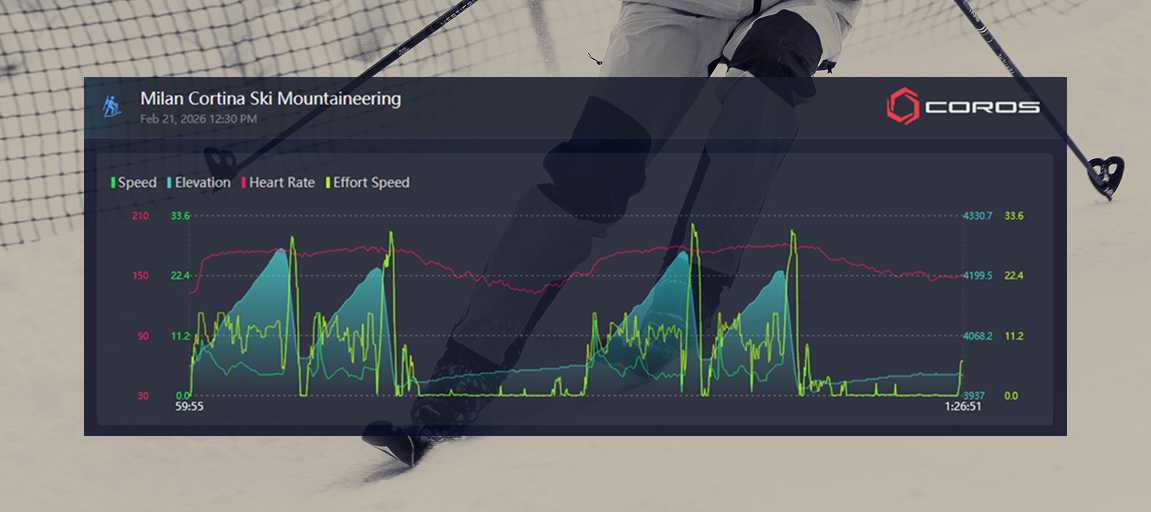
During the relay, the majority of Anna's legs were spent at threshold or above. Even at the start of each bout, she took less than 30 seconds to climb into that zone. Physiologically, she had to endure repeated spikes of effort during technical transitions and steep climbs.
Her heart rate profile shows no true "recovery” during her relay effort, oscillating at or above lactate threshold for nearly the entire leg. While her relay partner was skiing, her heart rate only dropped into the "recovery" zone for about a minute before it was her turn again.
Now compare that to her performance at the 2025 World Mountain & Trail Running Championships:
| Metric | Olympic Skimo Relay | World Trail Championship |
| Max HR | 182 bpm | 180 bpm |
| Average HR | 176 bpm | 173 bpm |
| Duration | 14:48 (Active Time) | 1:16:26 |
| Time at Threshold | 89% of Active Time | 90% of Total |
| Above Threshold | 4% of Active Time | 5% of Total |
| Impact Stress | Low | High |
| Technical Load | High | Moderate |
Aside from the total duration, the stats are nearly identical. The key takeaway?
Her Olympic skimo effort was as physiologically demanding as a world championship trail race, but with significantly lower muscular impact.
Johanna Hiemer – Olympic Mixed Relay
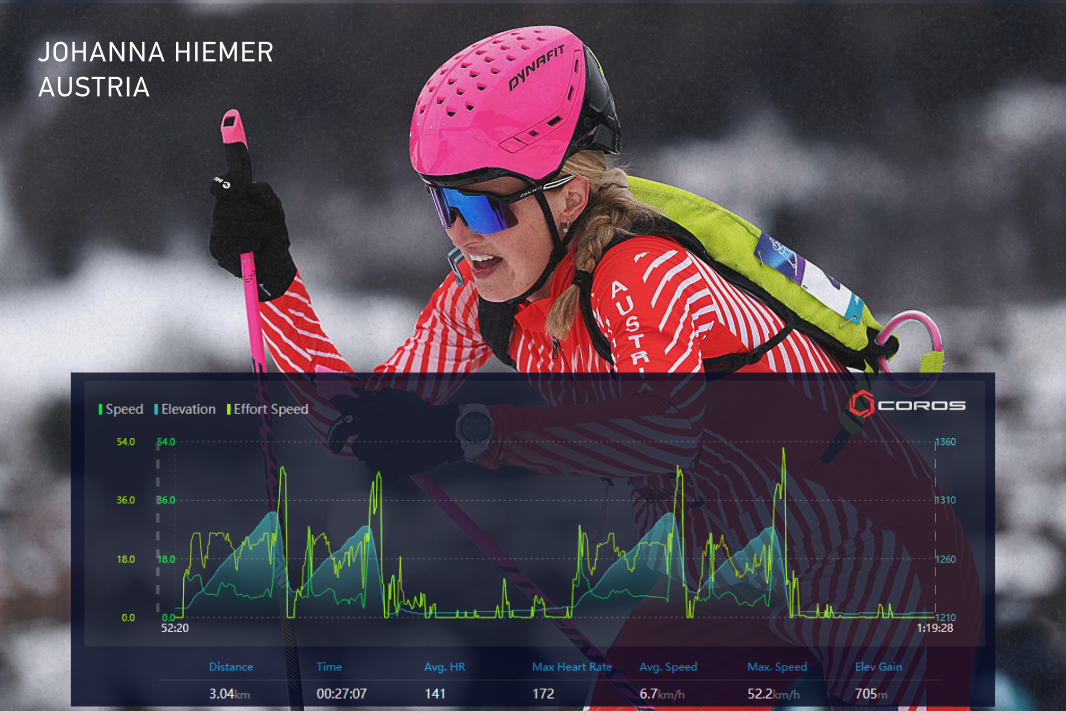
Johannah's data shows a similar story. With a threshold HR slightly lower than Gibson, Johannah's heart rate peaked at 172 on her final leg. Her data shows how much effort oscillates during the transitions. Stopping, making the required equipment adjustments, and accelerating again is much more taxing than maintaining speed.
However, Johanna (also experienced in trail running) noticed the same advantages of the sport. She describes the difference simply:
“Trail running involves much higher impact, especially on the joints… In ski touring, the joint impact is far lower, but in terms of strength endurance you get a different kind of push.”
In other words:
- Trail running = high aerobic + high impact
- Skimo = high aerobic + low impact
For endurance athletes looking for aerobic gains without digging a recovery hole, this is a potential solution.
Ana Alonso – Olympic Sprint Event
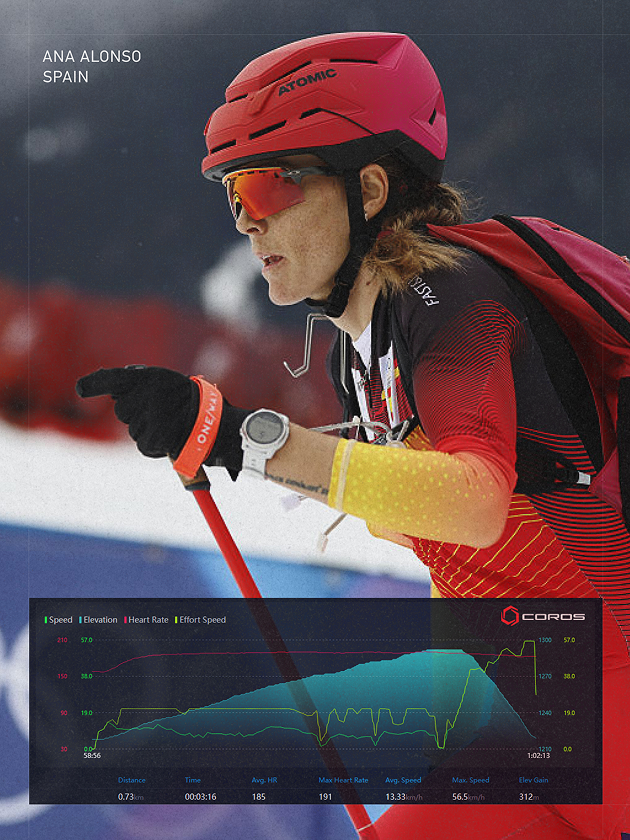
Ana clenched the bronze medal in the individual skimo sprint. This format was shorter than the relay legs, meaning intensity was even higher.
Ana's heart rate averaged 185, topping out at an astonishing 191. The higher intensity of the sprint event shows that skimo applies to more than just threshold work. If training demands it, you can push towards maximal output on skis.
Precedent from an All-Time Great
Elite mountain athlete Kilian Jornet has long used skimo as a winter tool to increase fitness while reducing stress on his body. Nearly his entire off-season build is done via skimo, and his Base Fitness reaches some of its highest points. Kilian discusses this strategy in depth in his cross-training philosophy.
His time-in-zone distribution during skimo training typically shows:
- Large amounts of Zone 2 volume
- Significant time in Zone 4
- Minimal neuromuscular damage compared to downhill running
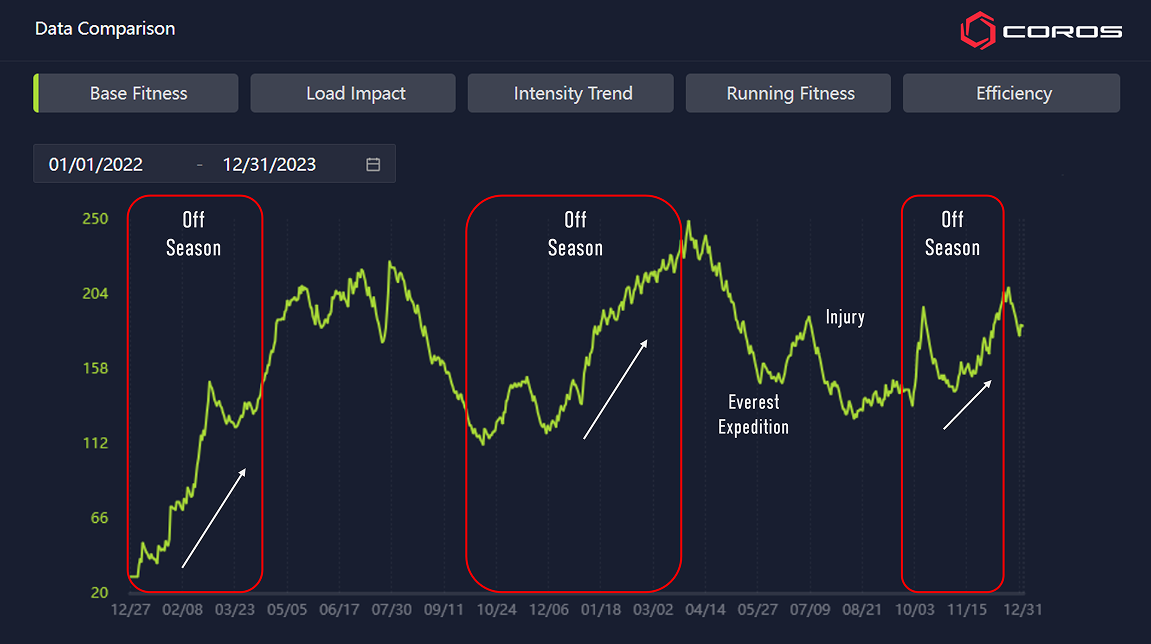
Kilian Jornet's Base Fitness trends over time
The data comparison (see Base Fitness chart in the COROS app) reveals a pattern:
Winter skimo blocks often coincide with sharp increases in aerobic base fitness.
For athletes managing long seasons, this is critical.
Anna Gibson: A Case Study in Transfer
Anna entered competitive skimo just months before the Olympics. She went from trail runner to Olympic skimo racer in a single season, and her relay finished 4th in the world.
She reflected:
“Skimo has taught me to believe in myself in a new way… I had to learn that evidence isn’t the necessary ingredient — BELIEF is.”
While not everyone can pick up skimo and become an Olympian, Anna's case shows that there is strong crossover between skimo and other endurance sports. You won't be starting from scratch on your first day.
From a physiological standpoint, skimo delivered a nearly identical training stimulus. Not to mention the added experience of competing on a global stage. From a performance standpoint, Anna may enter her 2026 trail season stronger than ever.
Why Skimo Might Be the Perfect Off-Season for Endurance Athletes
Across interviews with Anna Gibson, Johanna Hiemer, and Ana Alonso, a pattern emerged:
1. Massive Aerobic Development: Repeated threshold climbs build VO2 max and lactate clearance.
2. Lower Musculoskeletal Impact: No pounding descents like trail racing.
3. Technical Engagement: Transitions and downhill control sharpen coordination and focus.
4. Novel Stimulus: The body adapts more when the stimulus is unfamiliar. Skimo presents an opportunity to train the same systems, but with more bang for your buck.
5. Psychological Growth: Olympic-level pressure requires belief and resilience.
Ana Alonso summarized it beautifully:
“You only depend on yourself… and you appreciate it more when you reach the peak of a mountain and enjoy the descent.”
What This Means for You
The Olympic skimo data shows that you can spend meaningful time at and above threshold without the same mechanical cost as running. That changes how we should think about off-season structure.
If you are a trail runner, gravel cyclist, climber, or mountain athlete, skimo can serve as a high-stimulus, low-impact aerobic block. The goal is not to replace your primary sport, but to build the engine while reducing breakdown.

Winter weather can provide limitations to other outdoor sports, causing reduced or inefficient training. Skimo is built for winter weather, and creates high aerobic stress with significantly less pounding. It's better suited to the climate and gives your joints and tissues a break.
Lastly, with tools like the COROS APEX 4, COROS HRM, and the COROS App, you can monitor your Base Fitness and Training Status to ensure that you're staying on track.
Do that well, and when spring arrives, you can step back into your primary sport with a stronger aerobic engine and a higher ceiling.
The Bigger Picture
Skimo’s Olympic debut put it in the spotlight. But the real story for many athletes is what the sport does to the body.
The data shows that Olympic skimo efforts rival world championship trail races in intensity, all while reducing mechanical strain. For elite athletes, that means progression without breakdown.
For the rest of us?
It might be the smartest winter training decision we can make.
If you’re curious what your winter could look like, explore your training data inside the COROS app and consider stepping into the mountains this season.