
/filters:quality(90)/fit-in/970x750/coros-web-faq/upload/images/164caec8c39fc1342f38109f47e6ecf4.png)
Most runners believe the same thing, whether they say it out loud or not: if they just had more time, everything would change. If they just had time to run more miles or recover better, the gap between where they are and where they want to be would start to close.
Charlie Sweeney built his career on the opposite idea.
On most mornings, his day doesn’t begin on a track or a trail, but with a phone in his hand, answering messages. By the time many individuals are easing into their first cup of coffee, he has already cleared through Instagram DMs, scanned Reddit threads, and checked in on conversations happening across the COROS community. A meeting follows. Then another. The work is steady, sometimes unpredictable, and very much full-time.
Somewhere in between all of that, he trains twice a day. Not looking for more time, but only to maximize the time he has. And with that time, he's quietly building toward a performance that could place him among the top American finishers at the Boston Marathon.
The Path That Was Available
Charlie's story does not begin with inevitability. He was not a runner in the way most people imagine. Rather than specializing early, he played whatever sport was in season: football in the fall, basketball in the winter, and baseball in the spring. He was good at running, but it was no more than a tool to stay in shape for everything else.
That changed, almost quietly, after a football injury in high school. At 5’8” and 130 pounds, he had started to reach the limits of what the other sports could offer him. His running, on the other hand, kept improving.
He walked-on to Division II Western Colorado, where he spent a year redshirting. It was also a year of adjustment, wondering if he had made the right choice. Progress came slowly at first, then all at once. Before long, he had a top-15 finish at nationals, multiple All-American honors, and a scholarship. Ultimately he transferred and spent his final two years at one of the country's top Division I programs, the University of Colorado.
By the time his college career ended, he had done everything right... except secure any certainty about what came next.
So he did what most people do.
He got a job.
The Constraint That Stayed
Charlie joined COROS in 2023 in a customer support role. It was a position that demanded many things, but above all, it demanded time. There was no built-in flexibility for elite training.
Early on, he made a decision that would define everything that followed: his work would not bend around his running. His running would bend around his work. It is a subtle distinction, but a decisive one.

Three months into the job, he found his stride and began preparing for his first marathon. There was no ideal plan, only available hours. Training sessions squeezed into whatever space remained. Some runs started early, before working hours. Others in the evening after a long day of meetings. Often, to meet his training needs, it was both.
“I just figured out when I had time,” he said. “And I ran.”
What might have felt like a limitation began to take on a different shape. The lack of time did not force him to do less. It forced him to become efficient.
Learning to Be Where You Are
The physical demands were obvious. The mental ones were not.
For Charlie, the real challenge was not managing mileage or intensity, but managing attention. Time, stress, and relationships all compete in ways that are difficult to quantify. Meetings & schedules often shift, but training can't pause simply because the day has become more complicated.
The danger, he learned, was not in missing a session, but in being only partially present wherever he was.
“If I’m at work and thinking about running, I’m worse at both,” he said. “And if I’m running and thinking about work, it’s the same thing.”
Over time, he built a discipline that most professional runners never have to consider. Work is work. Running is running. Each demands full attention, and neither benefits from distraction.
It is not a perfect system. A phone call might occasionally interrupt a run, but the principle remains intact: wherever he is, he is there fully.
The Race That Changed the Equation
In December 2023, Charlie arrived at the California International Marathon with ambitious expectations with a realistic framing. It was his debut at the distance, and the goals reflected that. Finish in the top 10, and qualify for the Olympic Trials if everything aligned.
Instead, he ran 2:13 and finished third overall.
A result like that can become the defining moment of the season. For Charlie, it revealed how much he had overlooked. He saw room for improvement, something many first-time marathoners can relate to.
“I wasn’t fueling during runs. I wasn’t taking in electrolytes,” he said. “I realized right away there was a lot I could improve.”
The performance mattered, but not in the way it might appear. It was not validation so much as it was a signal that his ceiling was not yet defined. Moving forward, the gap between where he was and where he could be would not be closed by doing more, but by doing better.
Removing Guesswork
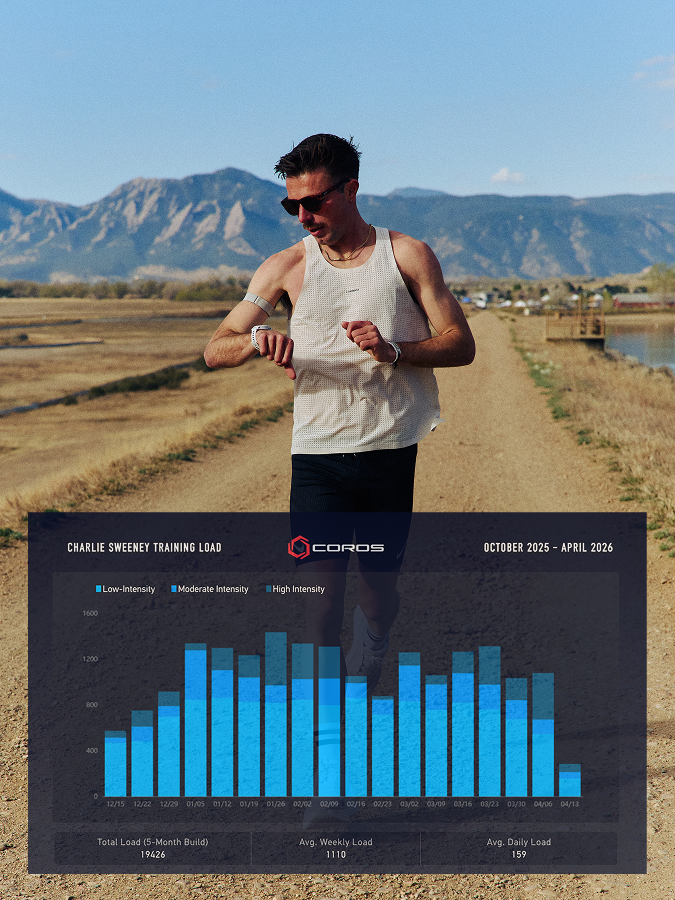
Charlie's Training Load leading into Boston
Training under constraint leaves little room for error. Charlie doesn't have excess time to compensate for poor decisions or inefficient work. His approach reflects that reality, seeking to quickly understand what he is doing and how his body is responding to it.
He tracks long-term trends in Base Fitness, monitors how individual efforts compare to expected outputs, and pays close attention to deviations. If a run feels harder than it should and the data confirms it, he adjusts.
“I can usually predict what a run should look like,” he said. “If it doesn’t match, I know something’s off.”
The goal is to eliminate waste. Every session contributes to something measurable, so he can evaluate and optimize for the next time.
In a schedule defined by limitation, that attention to detail becomes an advantage.
The Life Around It
There is, inevitably, a cost.
Charlie does not pretend that balance comes easily, or that nothing is sacrificed along the way. His days are structured, often rigidly so. Mornings begin with work, then a midday run. Afternoons he's back at the desk. Evenings close with a second session, followed by dinner, recovery, and sleep.
There is little space for excess. He hasn't finished a television series in years. Nights out are rare. Social plans are often secondary to the next day’s training. For Charlie, these trade-offs are an investment into his long-term goals, both on the roads and in the office.
What emerges is not a life divided between work and running, but one shaped by both. Each reinforces the other. The structure of his job prevents overindulgence in training. The demands of training sharpen his focus at work. The combination of both eliminates the remaining distractions.
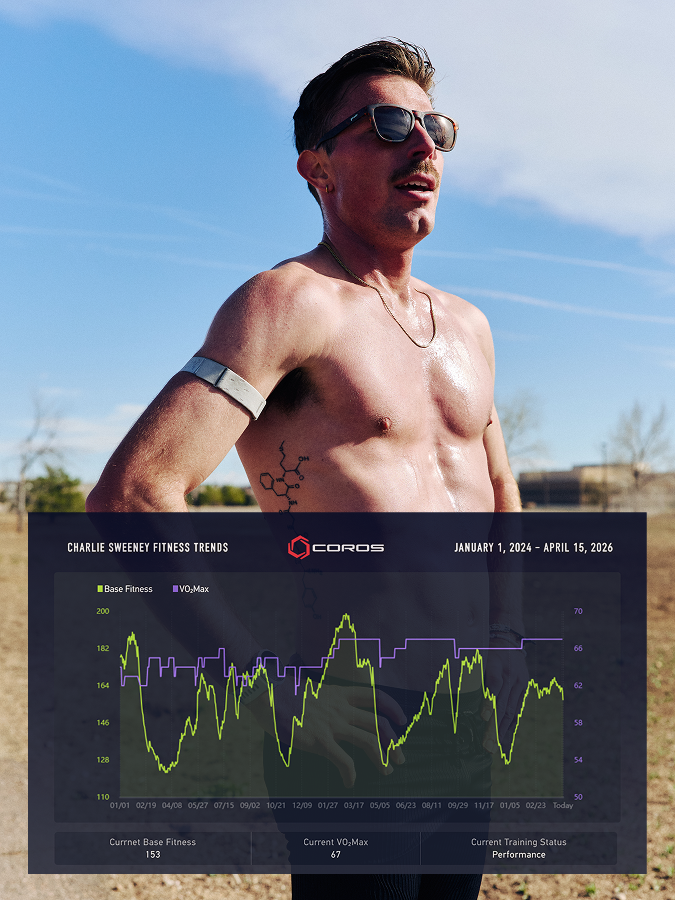
Charlie's Fitness Trends since he began working for COROS
The Question That Follows Him
The question is unavoidable: would he be better without the job?
Sweeney has asked it himself, more than once. The answer, at least for now, remains unchanged.
“I don’t think I would actually do anything differently,” he said.
More time, he believes, would not necessarily lead to better outcomes. It might introduce new problems. Overthinking, overtraining, an unnecessary fixation on marginal gains.
His work provides structure. It limits what he can do, but in doing so, clarifies what matters. When he finishes a day at his desk and steps out for a run, it is always an opportunity.
“I get to go run,” he said. “Not I have to.”
Beyond Boston
When Charlie lines up in Boston, he will carry specific goals; placement, time, execution. They matter, as they should. But they are not the defining measure of what he has built.
What matters more is the process that brought him there. Not the removal of constraints, but the decision to work within them. Not the pursuit of ideal conditions, but the refusal to wait for them.
For most runners, the assumption persists: that progress requires a different life, a different schedule, a different set of circumstances.
Charlie's experience suggests that isn't the case. Not that time doesn’t matter, but that it is rarely the limiting factor people believe it to be.