
/filters:quality(90)/fit-in/970x750/coros-web-faq/upload/images/fa7228836f64f358f5911a4cf73801dc.png)
Hannah Otto walked her road bike to the edge of the Pacific Ocean, dipped the wheel in, and started pedaling.
It's the ritual. Sea to summit. Every Mauna Kea FKT attempt begins the same way — a ceremonial acknowledgment that what follows is a continuous effort from waterline to the top of the world's tallest mountain. For Hannah, who spent the first decade of her career as a triathlete walking to the ocean to start races, the moment hit differently than she'd expected.
"I just felt all those emotions running back," she said, "of the 9-year-old girl, the 10-year-old girl, the little girl that I once was, attempting to do those big scary things back then — and what these big scary things have become now. Just the overwhelming joy of feeling like all my dreams have come true."
On October 23rd, 2025, Hannah rode 55 miles and nearly 14,000 feet of climbing from sea level to the summit of Mauna Kea in 5 hours, 43 minutes, and 50 seconds. A new FKT.
Bike Computer: COROS DURA
Watch: COROS APEX 4
Accessory:COROS Heart Rate Monitor
Why Mauna Kea?
Hannah set FKTs on White Rim, Kokopelli, and the Whole Enchilada before setting her sights on Hawaii. In fact, Mauna Kea was a destination she'd been circling for a while.
"I love superlatives," she said. "Hearing that this is the hardest climb in the world really stole my attention." She researches FKT candidates methodically: blogs, videos, route data, elevation profiles. "Every tab on my computer was about that climb."
The reputation is earned. The first 42 miles gain 7,000 feet. The final 13 gain another 7,000 — on a road that climbs to nearly 14,000 feet of elevation and passes through eight climate zones. There's no technical descent or even flat recovery. Just continuous, compounding effort.
There was also a personal dimension. Hannah’s triathlon races in Hawaii launched her career as a professional. That made it all the more impactful as she returned on her own terms after two decades.
"I wanted to go back and attempt something in these new shoes," she said, "and have a full circle moment."
The Plan, and the Reality
Twenty years of professional racing changes how you think about preparation. For Mauna Kea, Hannah didn't need to overhaul her training. The durability required for a five-plus hour effort at altitude doesn't come from a single training block. It accumulates. "It's more about what I've done over the last 15 years of my career,” she said. “I've done many 30-hour training weeks in my life. I know what it takes to be durable, and I know what it takes to suffer."
What she and her coach focused on instead was a plan for the specific physiological demands of the climb. The built a pacing strategy around the elevation profile and, crucially, the power decline that is inevitable with the increasing altitude. Their track record with game plans is top-notch: in every FKT attempt they've done together, the pace and strategy has landed within 10 watts of the target.
The logistical challenge was the calendar. Hannah raced Little Sugar and Big Sugar on back-to-back weekends, then flew directly to Hawaii. She'd learned earlier that year how much 24 hours of travel can cost a body that just raced. Following the recovery data from Hannah's APEX 4, they made the decision to allow more time for Hannah to recoup from a heavy week and pushed departure by a day to build in recovery before the attempt.
Then mother nature intervened. The original plan was to push the attempt as late in the week as possible, maximize recovery, and get a proper recon day on the mountain. After one recon day, the window closed.
"Weather was coming in," Hannah said. "The wind was gonna get worse and worse all week. The rangers told us the gravel road was being graded, and it would be somewhat unrideable if we waited any longer."
The attempt moved forward by several days. But, as a veteran in the cycling world, Hannah wasn’t fazed. Being adaptable is often part of the game.
"That's just where I think the learning of being flexible and trusting your body to respond to the ask comes in."
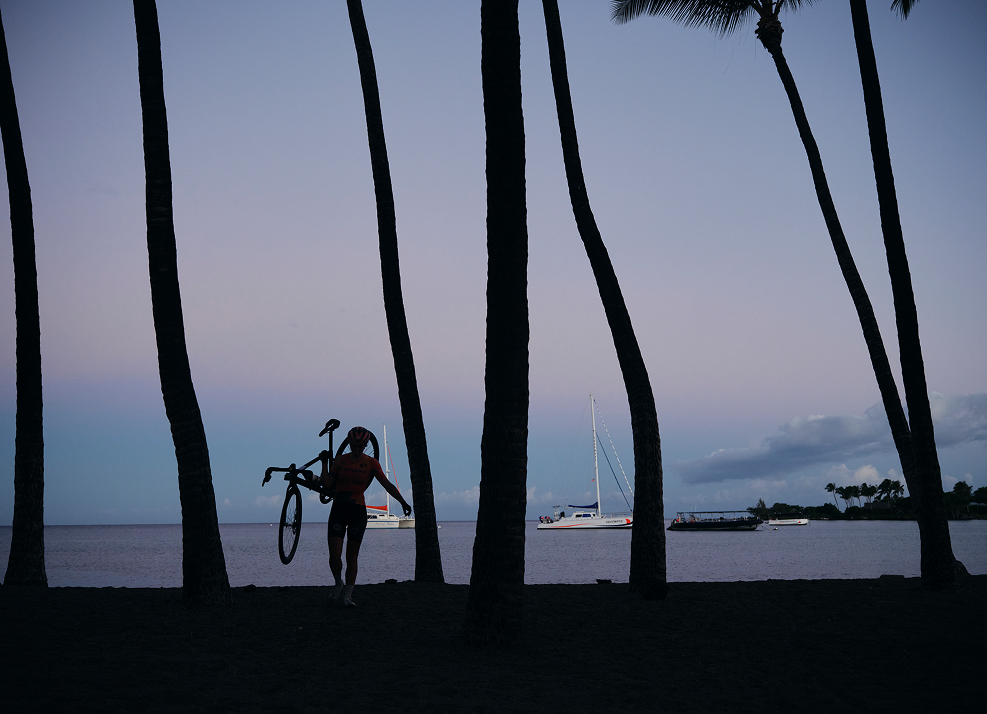
When FKT morning came, Hannah couldn’t help but feel the full-circle moment. Walking to the ocean to start races is a triathlete ritual she’d done here before. Now she was standing at the waterline with a road bike, about to attempt something entirely different, she felt all of it at once.
She dipped the wheel in and started climbing.
The Ride
Hannah and her coach had built the pacing strategy around one core tension: don't burn reserves on the early miles, but don't go so conservatively that you've already lost the FKT before the hardest climbing starts.
She monitored her power output and the mountain's elevation profile on her COROS DURA bike computer, pairing it with the COROS Heart Rate Monitor to track how her cardiovascular system was responding relative to power output. Power was the primary input. Heart rate was the backup check for when altitude factored in.
"How is my heart rate responding? Is this a heart rate I normally would expect to see at this power? And how are those things beginning to inversely relate?"
At altitude, the relationship between power and heart rate drifts. Output drops; heart rate doesn't necessarily follow. Understanding that divergence in real time — not just reading the number, but interpreting what it means about the state of the body — is what the dual data stream made possible. Hannah averaged 197 watts across the full effort with a normalized power of 205 watts, tracking closely to the targets they'd modeled in advance.
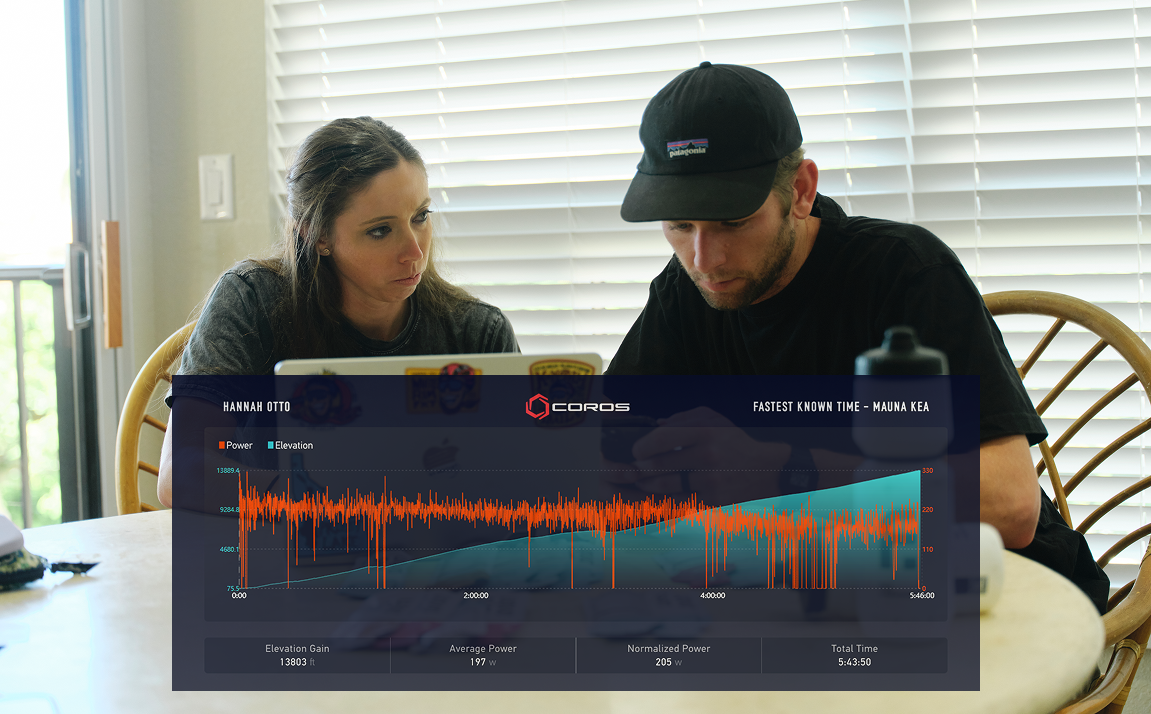
Twenty miles in, the wind was manageable. Hannah was six minutes ahead of the record.
By mile 40, with 15 miles remaining, she was three minutes behind.
"It was the realization of, oh my gosh, I've flown all the way here, I've set this goal, I've told everyone I can do this, I have a film crew here to document this record. All of a sudden, I'm doubting if I can do it."
FKT weather is different from race weather. In a race, everyone suffers the same conditions. An FKT is a competition against a time set on a different day, in different weather, by a different person. There's no shared suffering. There's no drafting off the field. There's just you and the number.
"The relentlessness of that wind was really mentally and emotionally exhausting. Since it's a climb with no reprieve, you basically go in one direction all day. It's really easy to get locked into a fatalist mindset of, 'this is never gonna end, I'm never going to pick up the speed I need. It's like you're running into a brick wall.' You have to be more relentless than the conditions."
And then, three minutes down with the record slipping away, the asphalt turned into four miles of loose gravel.
One Bike
Mauna Kea cyclists face a choice near the summit: swap to a gravel bike for the final miles, or stay on the road bike and suffer through it. Hannah had come straight from a gravel race, so she had her gravel bike with her. The swap was a legitimate option, and her team had debated it seriously.
She stayed on the road bike.
"Call it the purist in me — I really wanted to prove that you can do this on one bike," she said. "I always think about how these FKTs and these videos might inspire others to try these attempts, and I wanted to show you can go to Hawaii with a single bike and attempt this. You don't have to come in with a whole squad of equipment."
She ended up walking briefly on the gravel, but says that the bike switch wouldn’t have changed that.
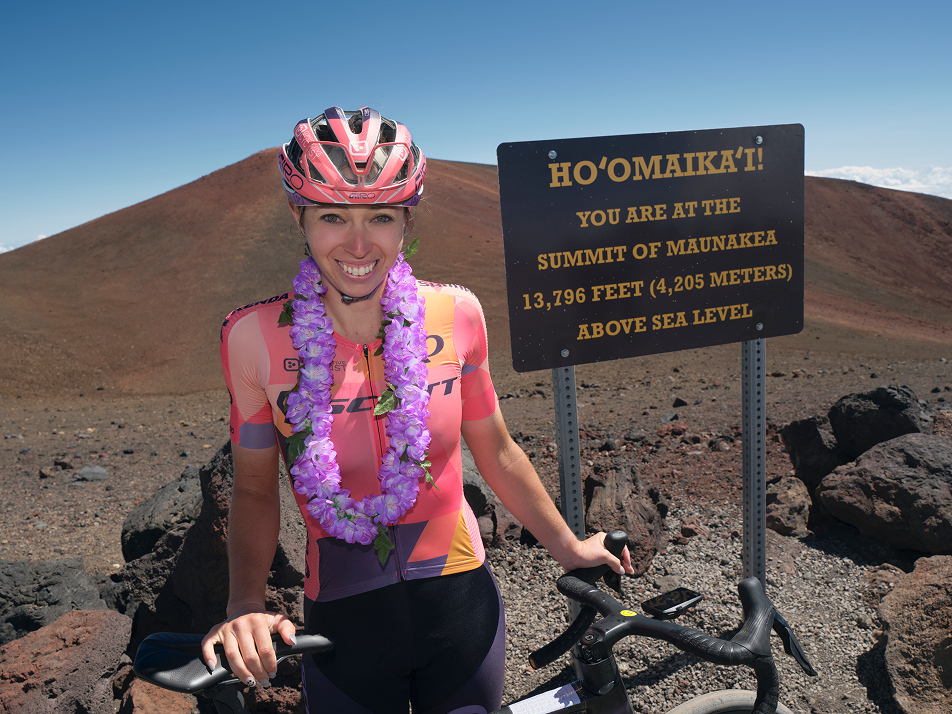
At the summit of the 13,803-foot mountain, she finished in 5:43:50.
"The action of overcoming that doubt and saying, 'I don't care if you're unsure if you can do it, you have to give it everything you've got regardless' — that's the piece of this climb that will stick with me forever."
Hannah also shares that these attempts are so much more than a collection of records. It reveals what all humans find when they push to their absolute limits.
"You are capable of so much more than you realize, and I believe that so deeply in my core. Every time I think I have reached my limit, when I'm truly faced with the limit, it disappears. It's only when you're standing far away from the limit that you can be like, yeah, that's as far as I'm willing to go. But once you come up against it — oh my gosh, okay, if I had to, I could go further."
In the end, Hannah believes that pushing your limits is something every athlete should experience. The definition will be different for everyone. For her, that was an FKT on Mauna Kea.
"Go do something that scares you. Because you're going to uncover a whole set of abilities you never knew you had."