
/filters:quality(90)/fit-in/970x750/coros-web-faq/upload/images/a1a68b930ecb93812590dec967f1976b.png)
Most people preparing for the Boston Marathon are chasing a time they've built their entire season around. They have a set pace per kilometer, splits memorized, and aerobic fitness sharpened over months of road work. Petter Engdahl is headed to Boston with something different.
The Swedish trail and mountain runner, one of the sport's most accomplished competitors, will take to the start line not with a road runner's resume but with something arguably better suited to what Boston actually demands: years of racing terrain that fights back.
Boston Is Not Berlin
There's a reason Boston doesn't produce world records. The course is net downhill from Hopkinton to Boston, which sounds fast until you're 30 kilometers in, your quads have absorbed thousands of eccentric impacts, and you're staring up at Heartbreak Hill with nothing left.
The athletes who run Boston well are rarely the ones who ran the first half fastest. They're the ones who treated the early kilometers as a loan they'd have to repay, and were disciplined enough not to overborrow.
That calculus favors trail runners more than the marathon world typically acknowledges. On trails, effort management isn't a tactic. It's the name of the game. Pace becomes meaningless when the terrain shifts every few hundred meters. What matters is reading your body, holding back when the ground feels generous, and staying within yourself when it gets hard.
Engdahl has been doing exactly that for years in the mountains. Boston is just the next terrain.
Applying the Trail Mindset to the Road
Engdahl isn't approaching Boston as an outsider trying to fit in. He knows that even as a mountain runner, the challenges of this marathon are a new flavor of a familiar recipe.
The effort management piece comes first. On trails, pace is irrelevant; the terrain decides it for you. What Engdahl controls is internal load: heart rate, perceived effort, how deep he is into his reserves at any given moment. That calibration is built over years of racing in conditions where reading your body correctly is the difference between a strong finish and a death march. "I will try to use effort as much as possible and listen to my legs," he said. It's the best way he knows how to race.
Boston rewards exactly that. The opening descent is deceptively generous, and the temptation to bank time is real. But the quads are quietly absorbing eccentric damage on every downhill stride, and Heartbreak Hill arrives at kilometer 32, when there's no hiding from whatever was spent early. Engdahl's trail instincts — hold back when the ground feels easy, stay within yourself before it gets hard — are precisely what the course is testing for.
Then there's the durability. "I think I have mental and physical endurance," Engdahl said. "42k feels pretty short to me, so I feel prepared to race for that long." That's not a knock on the marathon distance, but a reflection of what years of ultras and mountain racing do to an athlete's sense of what manageable effort feels like. He's also confident in how he finishes. "I know that I finish races strong." On a course that breaks athletes in the final 10 kilometers, that's not a small thing.
His VO2 max gives him a specific edge for the late hills. Where a road runner's heart rate spikes on the Newton climbs, Engdahl expects to find his footing. "When I hit the hills, that's maybe when my trail running experience will make the difference."
Adapting Trail Training for the Marathon
Engdahl's typical winter looks nothing like a marathon build. He skis heavily through December and January and runs just enough to maintain fitness. This season, he scrapped that entirely. Running was the priority from the start of December, and the volume jumped to 100 to 160 kilometers per week.
That's a dramatic increase in weekly load, almost entirely on road and flat terrain. The body noticed. "I do get more fatigue in some joints and shin bones," he said. Managing that load without breaking down became part of the preparation.
The focus areas shifted accordingly: stride mechanics, running economy, hip and calf strength. These are the things road running taxes that trail running doesn't demand in the same way. He began tracking his running economy in December, using lab testing and VO2 work to validate whether the changes were sticking. The day-to-day measure was simpler: pace at a given heart rate. Faster pace for the same HR meant the adaptation was working.
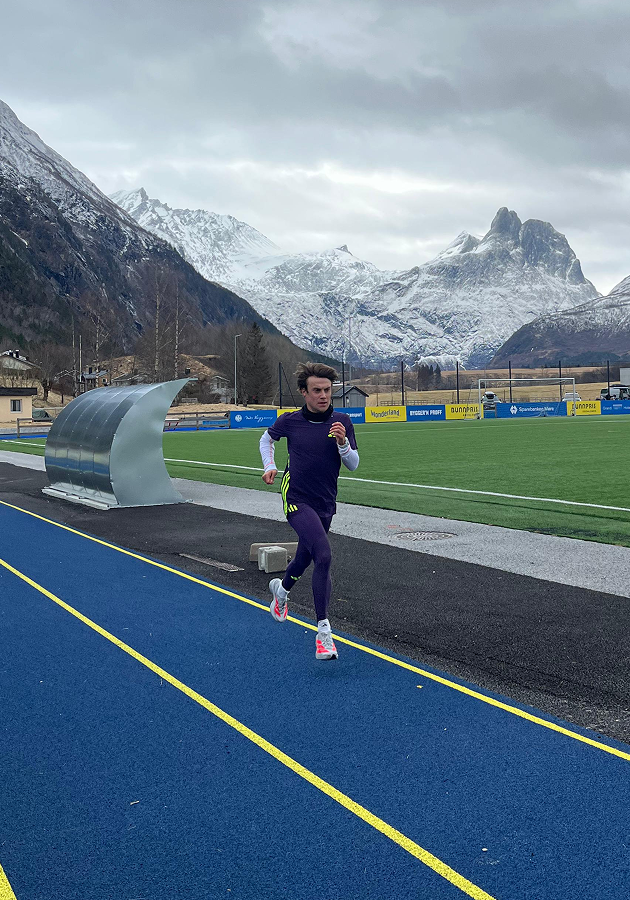
"In my preparations, the improvement in pace has been the most valuable," Engdahl said. "I correlate that to my HR. Based on my training, I know what pace I'm aiming for during the marathon."
Two sessions stood out during the training block. The first moved from road to treadmill: 32 kilometers easy outside, then a 11-kilometer progressive effort on the treadmill. The point was to learn to sustain output when the legs were already loaded, which is exactly what Boston asks for in the final 11 kilometers.
The second required a different kind of toughness. Training alongside Jon Albon in minus-15-degree conditions, Engdahl ran 25 kilometers easy before holding a full hour of steady-state effort. "It was a hard session," he said, "but it was great to do this type of training together."
Race Day: Effort Over Pace
When Engdahl describes how he'll run Boston, it sounds less like a road racer's race plan and more like an ultra strategy adapted for 42 kilometers.
"It's a hilly course and the start is a lot of downhill, so I think it's important to manage the energy and the legs."
He'll have pace on his screen, but it won't be running the show. "I will have a look at the pace, but try to be more focused on how I feel to do a good time rather than splits."
His daily HRV tracking gave him a real-time window into readiness throughout the build. This discipline is key for all runners who manage long, load-heavy blocks. Knowing the difference between fatigue that needs rest and fatigue that needs to be run through is a skill. HRV data helps make that call with less guesswork.
What does a perfect race look like for Engdahl? "A solid start, managing the hard sections, and a strong finish. I want to see some faster kilometers at the end."
Boston's terrain isn't favorable for a negative split, but it's not unheard of. For major climbs sit between kilometers 25 and 35. The athletes who have something left after it are the ones who were disciplined enough in the first half to save it.
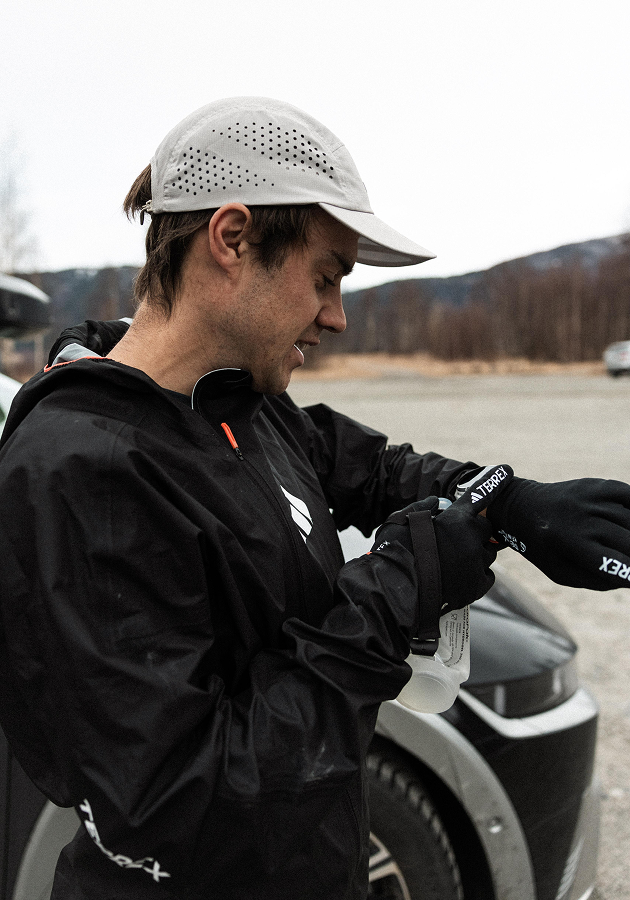
Practical Takeaways: Trail Runners at Their First Marathon
When crossing the lines between any two sports, there are inevitably some skills that will carry over. If you're coming from trails to a road marathon, the skills you've built in the mountains can be your biggest advantage if you use them correctly.
Run by effort, not pace. You already do this on trails. Bring that instinct to the road. Early splits can be misleading, especially on a course like Boston. Use heart rate or perceived effort to stay controlled in the first half.
Respect the eccentric load. Even if the course looks fast, downhill running accumulates damage. Your cardiovascular system may feel comfortable, but your legs are paying a price. Include downhill-specific work in your build to prepare for it.
Train for sustained output. Trail running includes natural variation and micro-recovery. Marathon running doesn't. Add longer steady-state efforts — Zone 2 into Zone 3 — to prepare your body for continuous load.
Use your durability as an edge. Trail runners know how to run on tired legs. That's exactly where you can outperform pure road runners. Stay patient early so you still have something to offer when others start to fade.
Simplify race execution. On trails, you manage terrain, navigation, fueling, and conditions simultaneously. On the road, remove the noise. Lock into a fueling plan, monitor your effort, and avoid surges that feel easier than they cost.
Petter Engdahl didn't come to Boston to run like a road racer. Whether that translates into the result he's chasing, we'll find out on race day. But the approach is sound. And for trail runners watching from the sidelines, his build offers something more durable than a race result: a blueprint.