
/filters:quality(90)/fit-in/970x750/coros-web-faq/upload/images/36a8932318512bb56621977d25db71eb.png)
Oliver Horton had every reason to race this winter. He was coming off a Colorado 4A cross-country title, an all-classification course record of 14:48, and a trip to NXN where he led Coronado to its first-ever team qualification.
Instead, the junior spent the winter doing fartleks on trails, running 300-meter hill repeats, and slowly building up his foundation. Four months later, he ran 8:38.95 for third at the Arcadia Invitational — one of the deepest 3200 fields in meet history — and followed it up with a state-leading 4:09 at altitude.
Watch: COROS PACE 4
Accessory: COROS Heart Rate Monitor
Analysis: Training Hub
The Winter Reset
After NXN, Horton took 10 full days off; he didn't even think about exercise. When he came back, it started slow. His first run back was just 10 minutes long. Eventually, he built to six days a week with Sundays off.
He trains in the winter with his club coach, Coach Potts, who communicates closely with his high school coach, Lisa Rainsberger. The transition between the two programs is seamless, which lets Horton build through the winter without any disruption when the school season begins.
"Up until probably the end of February, I wasn't doing anything fast," Horton said. "It was pretty much all just tempos, long runs, steady states, easy runs."
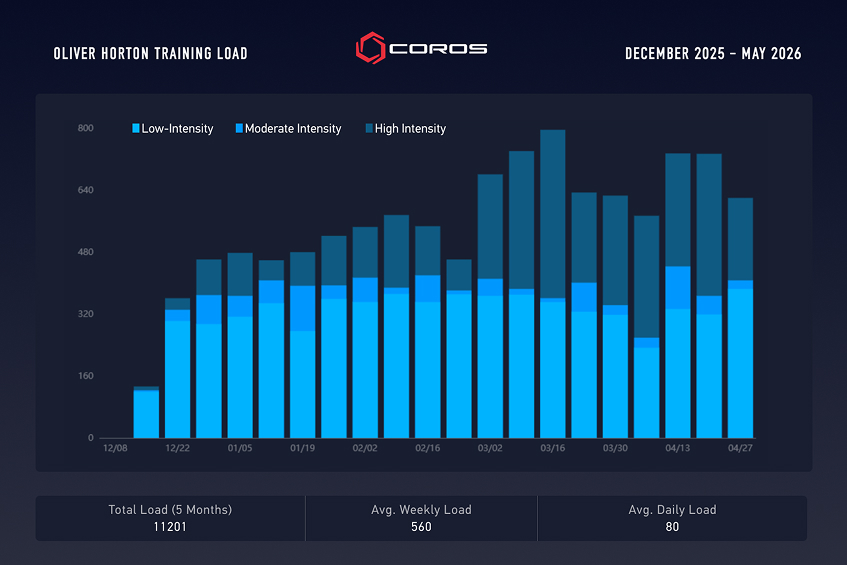
Oliver's high-intensity Training Load increased at the end of February
The decision to skip indoor came down to a conversation with Rainsberger. He was tired coming out of the cross-country postseason, and she saw more value in continuing to build than in sharpening for a race he wasn't fully ready for.
"She was like, 'You can, but you're not going to be very sharp for it, or we can just keep training,'" Horton recalled. "I'm happy I did that because I'm not tired at all. It feels like I just started the season."
What Base Training Looked Like
The bulk of Horton's winter work was built around fartleks and steady-state sessions on trails at altitude. A staple session was a descending fartlek: 7 minutes on at steady-state to tempo effort, 1 minute recovery jog, then 6 on, 1 off, 5 on, 1 off — all the way down, with a couple of extra 1-minute reps to close.
Another regular session was 300-meter hill repeats on a steep trail climb in the mountains outside Colorado Springs. "They weren't that fast, but it was high altitude, and it took like 60 seconds to get up the 300," Horton said. "You get through 6 reps, you still have 6 more, and you're dying."
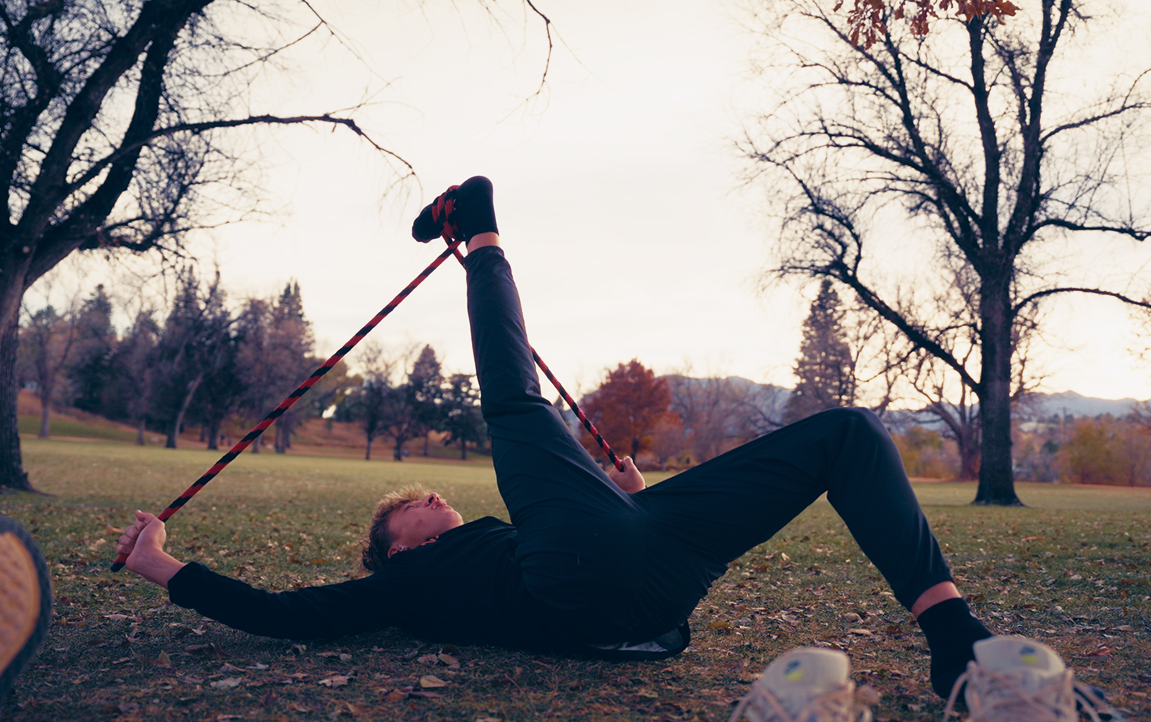
When he started transitioning to the track with Rainsberger's school program, speed was introduced gradually, and never at the expense of his aerobic side. It started with a few 200s at the end of sessions, then progressing to 12x400 off 60–90 seconds rest, and now to 600s and ladders. Everything has gotten faster as the season has gone on, but the aerobic foundation has stayed.
"In the past when we've gotten too specific all the time, I think I just lose what I'm best at — the aerobic part of it," Horton said. "I think I can run pretty fast off just doing aerobic stuff, so the specific sessions just kind of give me that last gear."
Arcadia
Horton went into the Arcadia 3200 knowing it would be the deepest field he'd faced on the track. His approach was simple: stay in contact and compete.
"The biggest thing was just staying confident and knowing that I have a pretty good kick," he said. "Just never let there be too big of a gap."
He placed third in 8:38.95 behind Jackson Spencer and Marcelo Mantecon. It was also a significant drop from his 8:56 altitude PR at the Niwot Invite a few weeks earlier. He felt like his kick could have been timed better, but the race confirmed what the training had been building toward.
"Me and my coach both knew I could run a time around there," Horton said. "It was just a huge confidence boost."
Heading into the race, Horton hadn't tapered. The only adjustment was working out a day earlier and pulling a few doubles out of the week. The same approach carried into his 4:09 mile at the Pueblo Twilight, another state-leading mark run at altitude, off full training.
What's Next
Horton's immediate focus is the Colorado state meet, where the time is irrelevant to him. "I just want to win no matter what it is," he said. "The time's irrelevant. It's altitude, it's championship racing."
After that, he'll race the mile at Runninglane (his first fresh mile at sea level) and then the 3200 at Brooks PR, where he expects to compete against another loaded field.
The approach won't change. "We're still going to try to keep it as aerobic as possible," Horton said. "Have one big aerobic session and one specific session. Just get the best of both worlds."
With one more high school cross-country season ahead before heading to UNC next fall, Horton is in no rush. The long game has been the plan from the start. So far, that patience is paying off.
Oliver is a member of COROS NextGen, a program which aims to work with elite high school athletes as they push their boundaries to become the next generation of elite distance runners in the U.S. For any high school athlete chasing their best, head to www.coros.com to learn more on products, training tips, and insights from athletes of all levels.