/filters:quality(90)/fit-in/970x750/coros-web-faq/upload/images/450d8f2b0ab714b871a8971ede8342cf.jpg)
An FKT on Mont Blanc isn’t an official race. There are no spectators or course markings, just a start point and a line drawn through glaciers, ridges, and high-altitude terrain. Yet within the endurance and alpinism communities these efforts carry immense weight, validated through GPS tracking and peer scrutiny.
What makes this ascent especially significant is how it blends disciplines: ski mountaineering, trail running efficiency, and data-driven pacing. And thanks to COROS tracking, this effort was a measurable one, offering a rare window into how elite athletes move through extreme environments.
A Brief History of Speed on Mont Blanc
FKTs on Mont Blanc are part of a long lineage of athletes redefining what “fast” means in the mountains.
The idea of moving quickly on Mont Blanc dates back over a century, but modern speed records began taking shape in the late 20th century. Swiss climber Pierre-André Gobet set a benchmark in 1990 with a time just over five hours, a mark that stood for decades.
Then came a turning point in 2013, when Kilian Jornet reimagined the mountain as a stage for endurance performance, completing the round trip in 4:57:40. His approach; minimal gear, aggressive pacing, and deep mountain intuition reshaped expectations.
Mathéo Jacquemoud himself has been part of this progression for years. In 2013, he set a ski mountaineering record of just over 5 hours, battling harsh conditions including -20°C temperatures and hard, irregular snow near the summit.
More recently, the pace accelerated dramatically:
- Benjamin Védrines pushed the time down to around 4:54 in 2025
- William Boffelli lowered it further to 4:43:24 shortly after
And now, Jacquemoud, this time alongside Equy, has taken it even further.
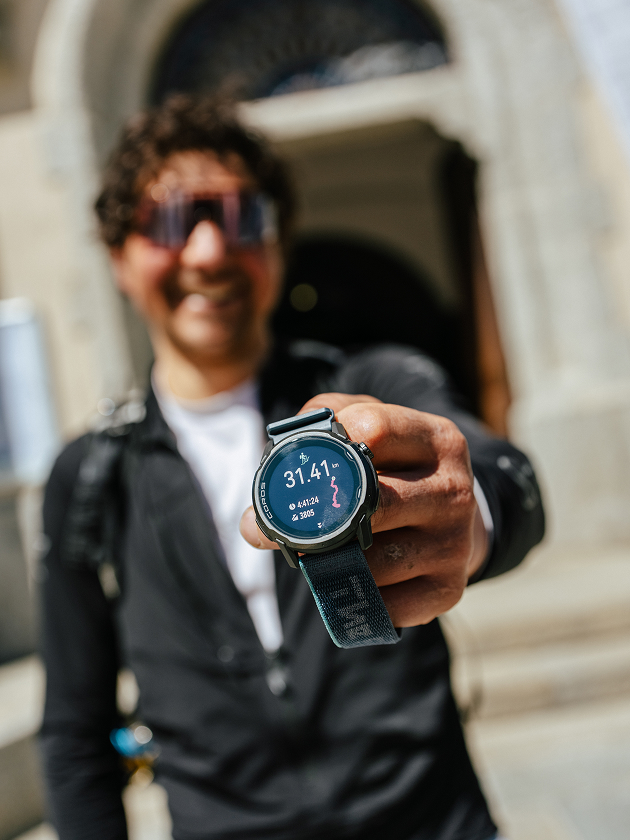
The Route from Chamonix
The Mont Blanc FKT route is deceptively simple: start in Chamonix, climb to 4,809 meters, and return. But within that simplicity lies enormous complexity. The standard round-trip route covers roughly 30 km distance with over 3,800 meters of elevation gain.
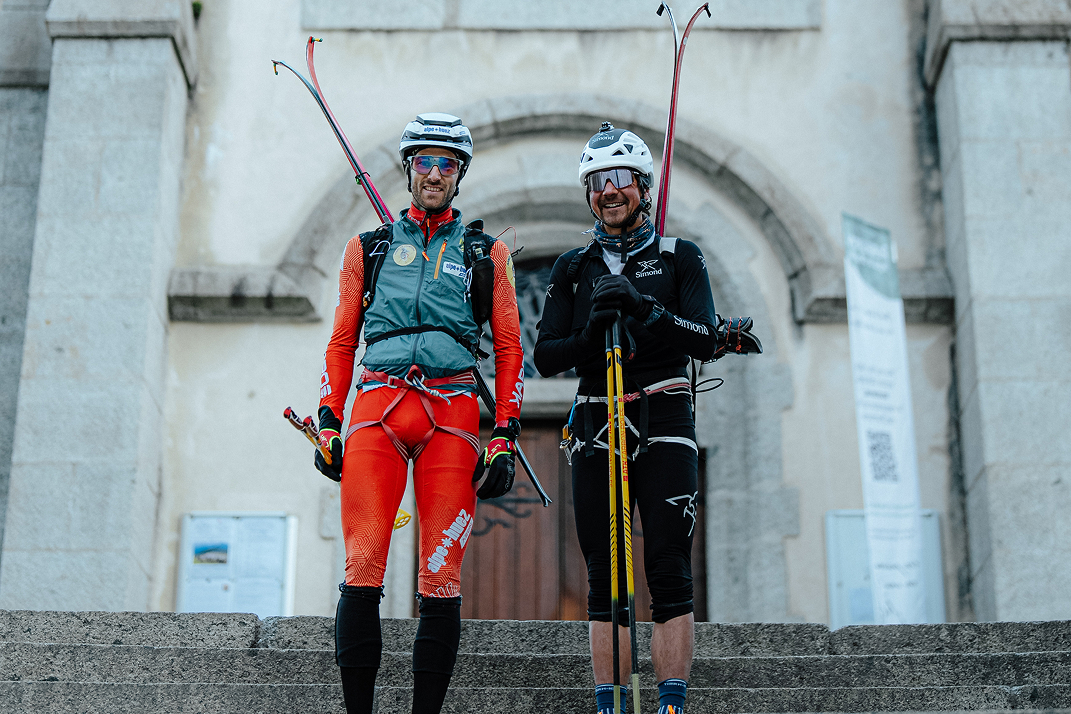
It begins at the church in Chamonix and typically follows the Grands Mulets route, weaving through glaciers, crevasses, and exposed ridgelines.
The climb unfolds in distinct phases:
Valley Start
The effort begins on runnable terrain out of the valley, where the gradient is manageable and the temptation is to go too hard, too early. The key here is controlled speed—moving quickly, but keeping effort firmly aerobic. Physically, this means holding back just enough to preserve energy for what’s ahead, even as the legs feel fresh and the pace feels easy.
Mid-Mountain Transition
As the route steepens and transitions onto glacier terrain, the rhythm changes. Footing becomes less predictable, and efficiency becomes about technique more than fitness. Clean ski transitions, confident movement over snow and ice, and smart line choice all come into play. From a physical standpoint, this is where steady output matters most: keeping effort consistent while adapting to more demanding terrain.
Summit Push
Above 4,000 meters, the mountain starts to dictate terms. The air thins, pace naturally drops, and every movement costs more. Speed takes a back seat, while managing stress is the focus. Breathing becomes more labored, heart rate climbs, and the focus shifts to maintaining forward progress without tipping over the edge.
Descent
The descent is where everything comes together. With firm snow and stable conditions, speed becomes an advantage—but only if it’s under control. Physically, it’s less about output and more about coordination and resilience under fatigue. This is where records are often decided: carrying just enough aggression to move fast, while staying composed enough to avoid mistakes that could leave you limping home in defeat.
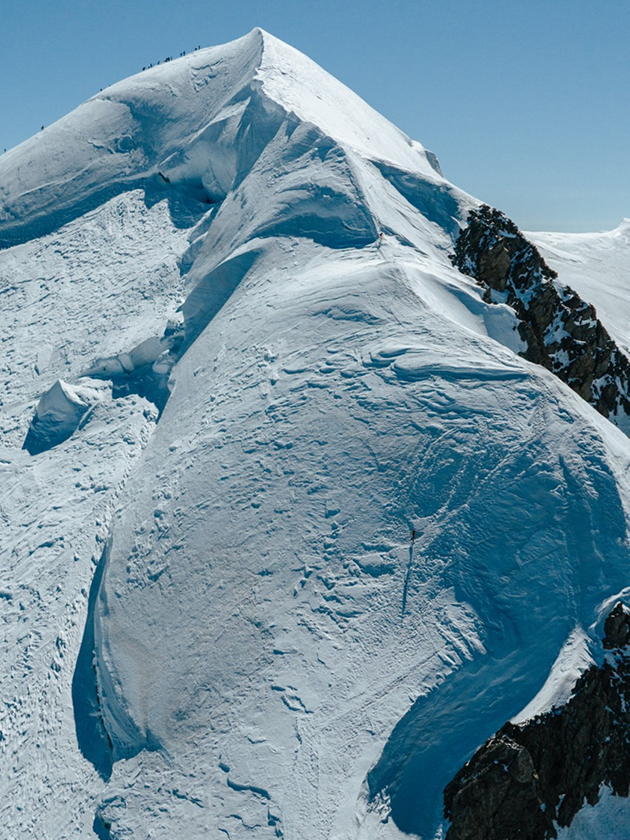
Taken as a whole, the route is less a straight line and more a continuous negotiation between terrain, altitude, and effort. Every section demands a different physical approach, and success comes from adapting seamlessly as the mountain steadily shifts the rules.
Inside the Numbers: COROS Performance Data
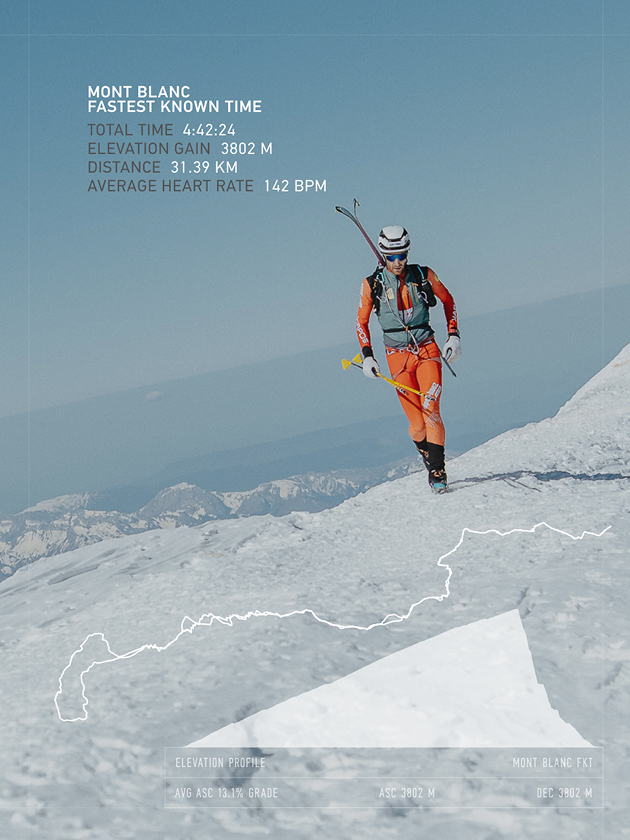
Behind the headline time lies a detailed dataset that explains how this effort was possible. What stands out is pacing discipline. Rather than surging early (where the route is flattest), Jacquemoud and Equy maintained a controlled effort, allowing them to sustain speed higher on the mountain.
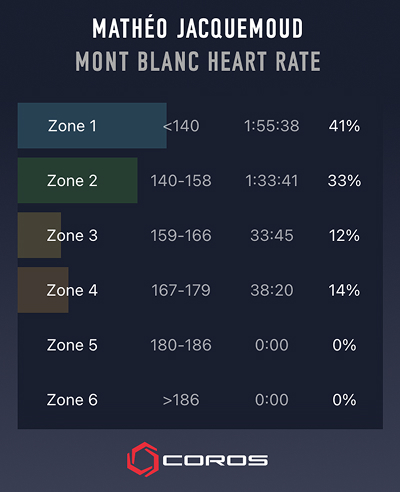
The heart rate data from COROS offers a clear window into how controlled and strategic this effort really was. 74% of the total time was spent in Zones 1 and 2 (41% below 140 bpm and 33% between 140–158 bpm), highlighting a strong aerobic foundation and disciplined pacing from the very start. Rather than pushing into high-intensity efforts, Jacquemoud and Equy stayed well within sustainable limits—crucial for an effort that climbs to nearly 5,000 meters. Time spent in Zone 3 (12%) and Zone 4 (14%) corresponds to the steeper, more technical sections and the summit push, where altitude and terrain demand higher output. Notably, no time was spent in Zones 5 or 6, reinforcing that this was not a sprint effort, but a finely tuned endurance performance. The data underscores a key principle of high-altitude speed ascents: success comes not from redlining, but from maintaining efficiency and control across dramatically changing terrain and oxygen levels.
Heart rate data typically shows a steady climb with altitude—less a spike, more a gradual strain as oxygen decreases. This aligns with what’s been observed in previous record efforts: success depends on managing effort, not maximizing it too early.
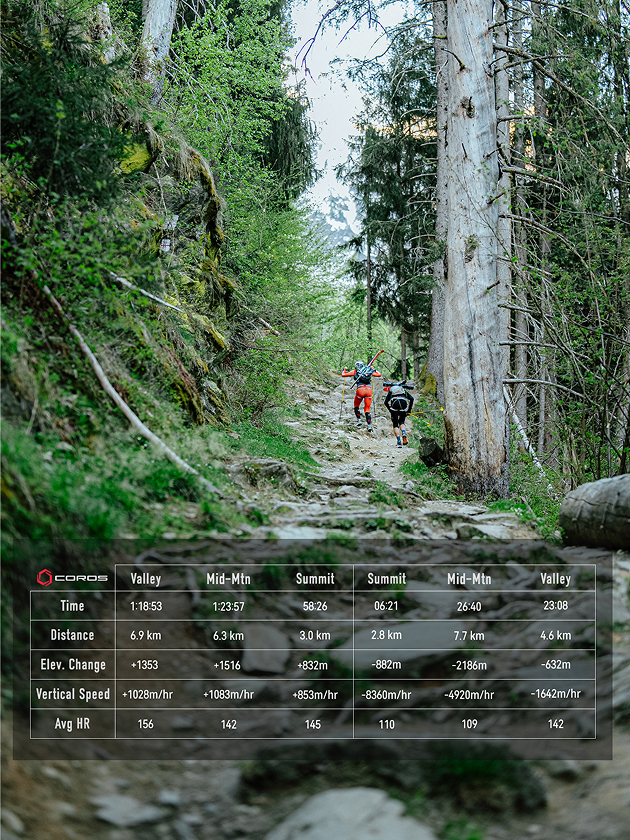
The lap data adds another layer to the story, especially when you look at vertical speed as a proxy for effort on the climb versus efficiency on the descent. In the opening valley section, the team moves aggressively, already climbing at 1353 meters per hour with an average heart rate of 156 bpm (upper zone 2), signaling a strong but controlled start. After the first transition, the pace picked up slightly before being slowed by the altitude and technical terrain of the summit.
Once over the top, the data flips dramatically. Heart rate drops to 110, and the vertical speed flips to -8360m/hr as they ski back down. For a brief moment, Mathéo reached a top speed of over 70km/hr. The fast, confident descending on favorable terrain is a difference-maker in this FKT. Mathéo's heart rate dropped as low as 91 bpm, indicating controlled intensity despite the speed. When they transitioned away from skiis in the valley, pace naturally slowed, but the team returned to Chamonix in record time.
COROS data transforms this from an impressive story into a repeatable framework. It allows athletes to analyze not just what was done, but how.
Conclusion
This Mont Blanc FKT marks another step forward, not just in speed, but in how these efforts are understood. Jacquemoud and Equy didn’t simply move faster; they executed with precision, balancing effort, terrain, and conditions from start to finish.
COROS data brings that performance into focus. It shows the restraint early on, the efficiency on the climb, and the calculated aggression on the descent. It turns a single effort into something others can study and learn from.
That’s where mountain sports are heading. The limits are still being pushed in the mountains, but increasingly, they’re being unlocked in the data.